

Affordability & Tenure

This report from Salt Spring Solutions aims to bring together a comprehensive set of solutions to the housing crisis on Salt Spring Island.

Key insights:

Salt Spring Island’s housing challenges are currently exasperated by several factors, including sprawl, demographic changes and strained infrastructure capacity.

As this report details, Salt Spring Island looks to address these by establishing a local housing framework that advances five strategies:

  • Strategy 1: Coordinated and Properly Resourced Local Approach to Housing
  • Strategy 2: Effective Public Education, Engagement, and Dialogue on Housing.
  • Strategy 3: Preservation of Rural Areas and Nature Space through Clustered Housing.
  • Strategy 4: Readying Ganges Village for More Housing
  • Strategy 5: Accessory Dwellings for Housing, in the Right Places

Amongst the key policy actions recommended include:

  • creating an entity to oversee and coordinate interagency tasks,
  • developing a public education and engagement policy,
  • updating policy and zoning regulations to incentivize compact,
  • clustered housing development,
  • intensifying growth in the town centre,
  • and permitting ADUs for long-term occupancy.
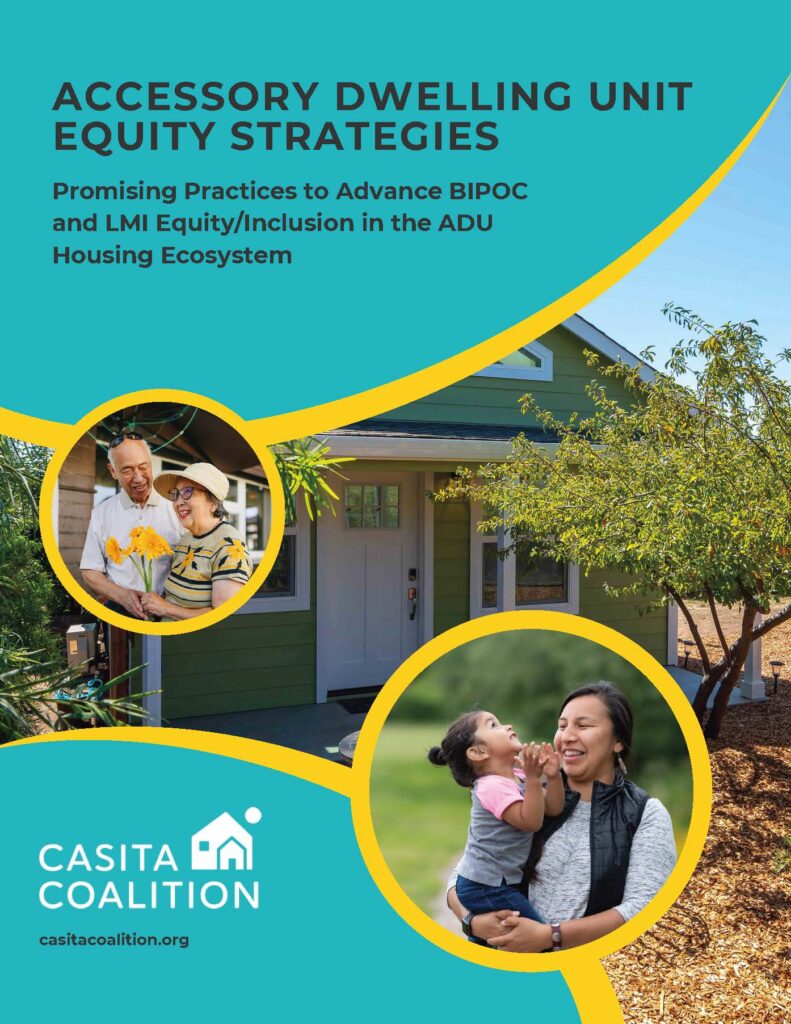
This report from Casita Coalition delves into key strategies and insights from both developer and municipal planner perspectives in advancing equity strategies as ADUs gain popularity and ease of construction across California.

Exploring Promising Practices for Equality in Housing Development

In the effort to promote equality and increase accessibility to housing options, municipal workers and housing developers are turning to Accessory Dwelling Units (ADUs) as a potential solution. This report from Casita Coalition delves into key strategies and insights from both developer and municipal planner perspectives to advance equity as ADUs gain popularity and ease of construction across California.

Overcoming Challenges & Equity Barriers to Ensure Equal Access to ADUs

Addressing equity barriers is crucial to fostering inclusivity in ADU development. This section examines the common hurdles, including a lack of reliable information, permitting challenges, upfront costs, and homeowner concerns about assuming the role of landlord.

Written for Casita Coalition by Lin Chin of Ground Works Consulting, with support from Jennifer Duffy of Hello Housing, Renee Schomp of Napa Sonoma ADU Center, and Miriam Zuk and Saneta deVuono-powell of Ground Works Consulting.

Infill Development in Edmonton: Strategies for Success brings leaders to better understand how public support is garnered for infill development in residential neighbourhoods and explore strategies that can be transferred to BC communities (including municipal policies and processes, partnerships, resources and engagement tactics/messages).

In this Gentle Density Network webinar from February 2023, learn how the City of Edmonton garnered public support for infill development in residential neighbourhoods, with insights from Nicholas Rheubottom, Executive Director at Infill Development Edmonton Association (IDEA), and Travis Fong, Co-Founder and President of YEGarden Suites.

Key insights:

There are many benefits to infill development:

More diverse housing stock: Infill helps to create diverse and vibrant neighbourhoods by providing options to meet everyone’s needs, whether it be new families, seniors, students, front-line workers, or more!

Financial Sustainability: Similar to above, by creating more diverse housing options, we can also cater for a greater diversity of financial needs and incomes.

Multigenerational Living: Enabling a variety of housing options in a neighborhood provides families with the choice to age in place, allows young individuals to reside nearer to the city center

Amongst the key barriers to infill include:

Infrastructure: At project inception, infrastructure upgrade costs are unknown and unpredictable.

Financial Feasibility: Medium-scale development from 4 units to 8 stories can be difficult to finance and has high risk brought on by contradictory planning policy, and uncertainty in approval processes and infrastructure upgrade costs

Local governments continue to face challenges with respect to housing supply and affordability. Gentle density infill housing strategies provide a promising way to increase housing supply in already built areas, but the question of affordability still remains.

To address this challenge, James Moore (City of Kelowna) and Matt Thomson (Urban Matters) joined Small Housing in April 2023, to share their insights with the Gentle Density Network on how the City of Kelowna has approached its efforts to increase gentle density supply and affordability.

The webinar also discusses Small Housing’s Guidance Paper (2023) that explores existing and emerging tools for local governments to increase the supply of gentle density and enhance its affordability.

Key findings:

  • Gentle density housing is more attainable than single-detached homes due to shared land costs, smaller square footage per unit, and shared building surfaces.
  • The local government tools listed can make it easier to build this form of housing, and can help to bring down the costs of development. This, in turn, will help to incentivize the production of new supply. As more supply comes online, housing prices cool.
  • If local governments stack the tools (and their related cost reductions), they may be able to create sufficient incentives to make the inclusion of below-market units viable within a development.
  • There are additional tools that can be leveraged by community partners, such as non-profits, lenders, and other levels of government, that can further support the creation of new and affordable gentle density homes.